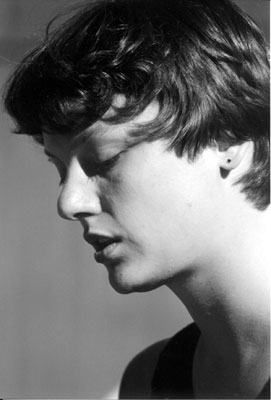
Authors
Kateřina RUDČENKOVÁ
The poet Kateřina Rudčenková was born in Prague on 12 April 1976. She studied at the Jaroslav Ježek Conservatory and the Agricultural College, and today works as a proof-reader. She is also the editor of the Internet monthly Dobrá adresa (Good Address), and lives in Prague.
Kateřina Rudčenková’s expressive lyric poetry may be characterized as Beckettian testimony to the essential isolation of the individual and the futility of communication. In this ‘anatomy of solitude’ (as the literary historian Vladimír Křivánek put it) human beings are eternally condemned to pass each other by, walking down black tunnels where their paths never cross. The utterances of her speakers are for them alone, an absurd monologue that has almost no chance of turning into meaningful dialogue. The poet stays inside the impenetrable shell that separates her hypersensitive self from the world, and survives in memories among disintegrating fragments of psychological dramas, in a dark landscape of grief, agonizing distress and fatal estrangement: ‘I am on the side of people I am just / What accompanies them like the wind or follows them / Like a beast senselessly’. Yet at times, glimmering through the scepticism, there is a dogged yearning to try once again to bridge the gap between two human monads, to surrender to the momentum of the world, and defiantly to force from it at least a second of harmonious being (‘I shall go further, I shall go, I shall hurl myself’). Rudčenková’s verse moves along a sinusoid curve; it oscillates between moments of real lived experience and moments of mere enduring, between peaks of joyful trembling that in their burning intensity are as long as a lifetime, and descents into the aimless and lethal nothingness in which the human consciousness is pulled into a vortex of absurd situations where, as the critic Jiří Zizler has remarked, we find ‘signs of a hidden struggle with the self-indulgence, indifference and languor that seductively draw the spirit into the depths of unconsciousness and numb immobility, into a faceless, nameless crowd. This continual oscillation of the lyric subject is also reflected in the dynamic structure of Rudčenková’s verse. Most often she works with verbs, sacrificing complicated metaphors and poetic ciphers to immediacy of impact and action. In her debut, Ludwig, ‘distantly inspired by the character of Ludwig in Ritter, Dene, Voss, by the Austrian dramatist Thomas Bernhard’, Rudčenková still employs the framework of formal poetic repertoire (from the haiku to the longer lyric compositions) and exploits the possibilities of mild stylization. In her second collection Není nutné, abyste mě navštěvoval (You Needn’t Visit Me) she has matured towards formal concision and expressive restraint, relinquishing the motifs from theatre, literature and mythology, which had previously enchanted and inspired her. The deepening of the basic theme, however, has meant a blurring of the poetic background. Instead of the real characters and concrete urban or natural scenery of the earlier poems, we see an empty house and in it a dusty room ‘in the region of whatever’. As the outlines of objects pale, as if they were sinking into snow, word and verse remain the last handholds. ‘I live in a language, in which / I store everything that happens’.
(rk)
Autor of the photo Wolfgang Kühn
Deutsch
Kateřina RUDČENKOVÁ, Deutsch.doc
En français
Kateřina RUDČENKOVÁ, En français.doc